
Documentation: https://cwimpy.github.io/slxr/
Spatial-X (SLX) models for applied researchers.
slxr makes it easy to fit, interpret, and visualize Spatial-X regression models in R. Unlike existing tools that treat SLX as a consolation prize for SAR, slxr centers the SLX approach and provides first-class support for the features applied researchers actually need:
- Formula-based interface — write
slx(y ~ x1 + x2, data, W, lag = "x1")and get a fitted model, not a wrestling match withlistwobjects. -
Variable-specific weights matrices — the defining feature of Wimpy, Whitten, and Williams (2021). Different covariates can spill over through different
Wmatrices (contiguity, alliance, trade, etc.) in a single model. - Higher-order spatial lags (
W,W²,W³) with clean effects decomposition. - Temporally-lagged spatial variables (TSLS) for panel data.
- Tidy direct, indirect, and total effects — for SLX these don’t require matrix inversion or simulation.
-
modelsummary-compatible output (viatidy()andglance()methods). - Sensible defaults plus diagnostics for comparing
Wspecifications.
Installation
Install the released version from CRAN:
install.packages("slxr")Or the development version from GitHub:
# install.packages("remotes")
remotes::install_github("cwimpy/slxr")
Example
library(slxr)
data(defense_burden)   # 1995 cross-section from Wimpy et al. (2021)

W_contig   <- slx_weights(style = "custom", matrix = defense_burden$W_contig,
                          row_standardize = FALSE)
W_alliance <- slx_weights(style = "custom", matrix = defense_burden$W_alliance,
                          row_standardize = FALSE)
W_defense  <- slx_weights(style = "custom", matrix = defense_burden$W_defense,
                          row_standardize = FALSE)

fit <- slx(
  ch_milex ~ milex_tm1 + log_pop_tm1 + civilwar_tm1 + total_wars_tm1 +
             alliance_us + ch_milex_us + ch_milex_ussr,
  data = defense_burden$data,
  spatial = list(
    civilwar_tm1   = W_contig,
    total_wars_tm1 = list(contig = W_contig, alliance = W_alliance),
    milex_tm1      = list(contig = W_contig, defense  = W_defense)
  )
)

slx_effects(fit)
slx_plot_effects(fit, types = c("indirect", "total"))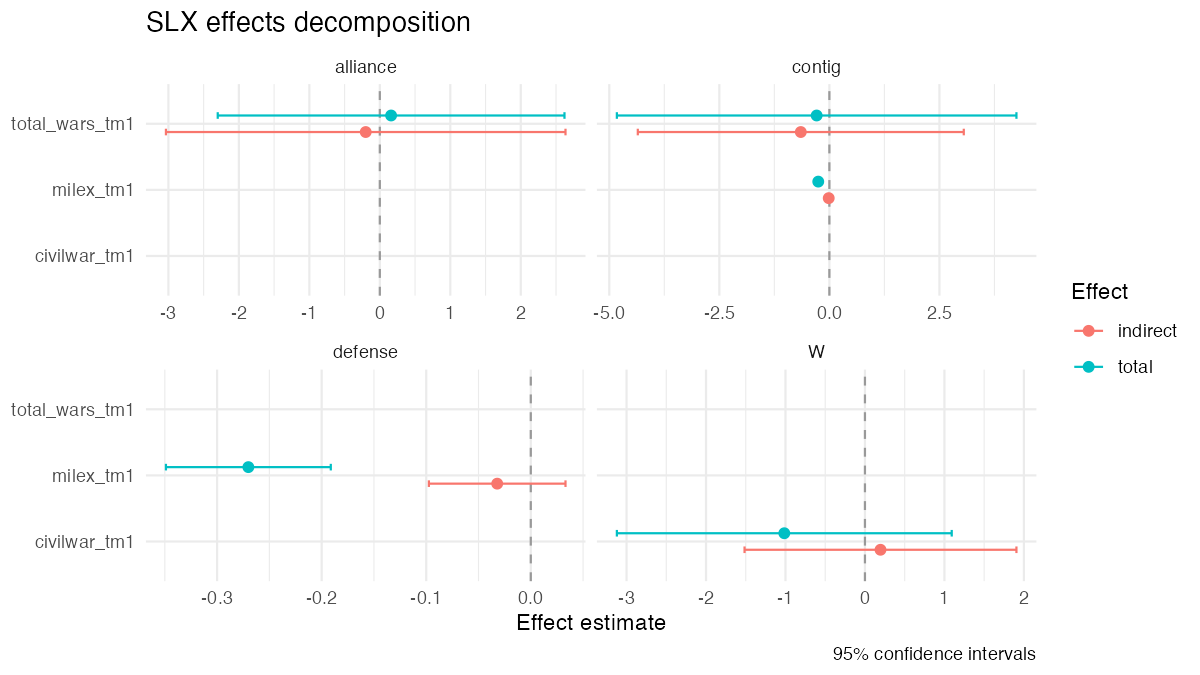
Variable-specific weights matrices:
Status
Available on CRAN. The current release covers SLX estimation with variable-specific and higher-order weights matrices, temporally-lagged spatial variables, tidy effects decomposition, modelsummary integration, and a slx_plot_effects() visualization helper. Additional diagnostics, vignettes, and panel-data workflows are on the roadmap — issues and pull requests welcome at github.com/cwimpy/slxr.
Citation
If you use slxr in published work, please cite both the package and the methodological paper it implements. Run citation("slxr") in R to see the current BibTeX entry, or refer to:
- Wimpy, Cameron, Guy D. Whitten, and Laron K. Williams. 2021. “X Marks the Spot: Unlocking the Treasure of Spatial-X Models.” Journal of Politics 83(2): 722–739. doi:10.1086/710089.
- Wimpy, Cameron. 2026. “slxr: Spatial-X (SLX) Models for Applied Researchers.” R package version 0.1.1. doi:10.5281/zenodo.19697570. https://cran.r-project.org/package=slxr.
References
Wimpy, Cameron, Guy D. Whitten, and Laron K. Williams. 2021. “X Marks the Spot: Unlocking the Treasure of Spatial-X Models.” Journal of Politics 83(2): 722–739. doi:10.1086/710089.
Vega, Solmaria Halleck, and J. Paul Elhorst. 2015. “The SLX Model.” Journal of Regional Science 55(3): 339–363.
LeSage, James P., and Robert Kelley Pace. 2009. Introduction to Spatial Econometrics. Boca Raton, FL: Chapman & Hall/CRC.